
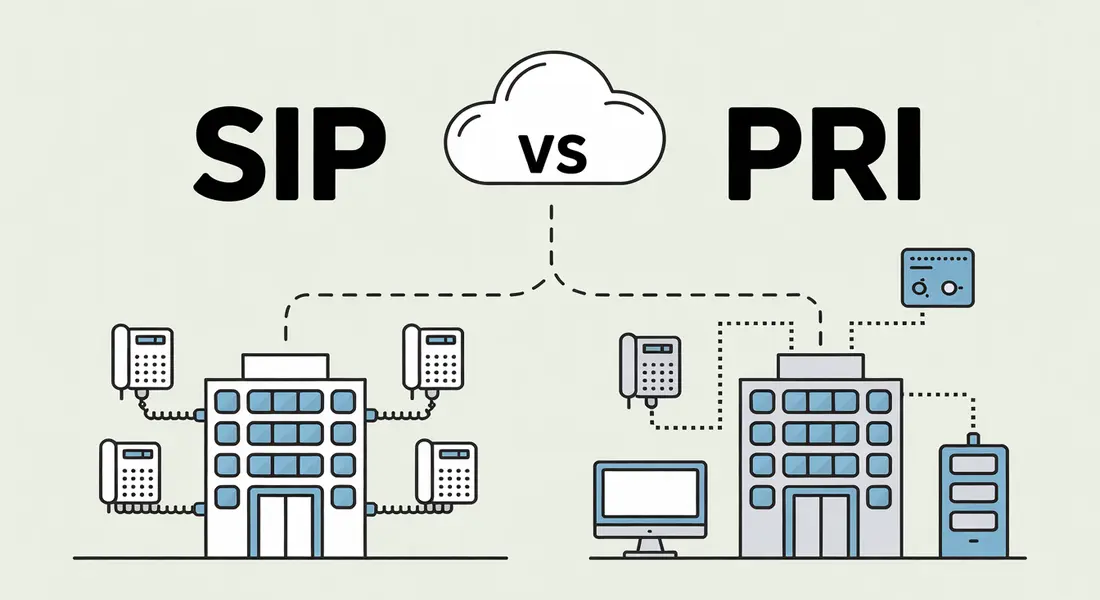
PRI (Primary Rate Interface) and SIP (Session Initiation Protocol) are two different technologies for business telephony. PRI is a digital circuit that provides voice channels over physical lines while SIP uses the internet to deliver calls through virtual channels. Choosing between them in 2025 depends on business size scalability needs compliance requirements and cost efficiency.
PRI trunks offer stable fixed-capacity voice channels (commonly 23 per circuit) with consistent call quality but they require on-premises hardware and higher maintenance.
SIP trunks provide flexible cloud-based channels that scale up or down instantly support remote work and integrate with hosted dialers and PBX systems. They are usually more cost-effective and enable advanced features like encrypted VoIP and global reach.
For businesses managing outbound sales and call center operations SIP is now the dominant choice in 2025 because it aligns with trends such as hybrid workforces AI-driven analytics and telecom compliance automation. PRI may still serve organizations with legacy infrastructure or strict on-premise security rules but the long-term momentum favors SIP.
What Is PRI and How Does It Work?
Primary Rate Interface (PRI) is a digital telecommunication standard that delivers up to 23 voice channels and one signaling channel over copper lines. Businesses use it to connect legacy PBX systems directly to the Public Switched Telephone Network (PSTN).
Each PRI trunk provides fixed capacity meaning a company can handle 23 simultaneous calls per circuit. This structure ensures reliable voice quality but requires physical cabling dedicated hardware and ongoing carrier contracts.
Because PRI is hardware-bound it scales slowly. Adding more capacity means installing additional circuits which increases both cost and maintenance. Despite these limitations PRI remains relevant in enterprises with on-premises PBX systems or industries requiring stable regulated communication lines.
What Is SIP Trunking and Why It Replaces PRI?
SIP trunking is a telecommunication method that uses the internet to deliver voice channels replacing the fixed circuits of PRI with flexible virtual connections. It enables businesses to route calls through VoIP networks instead of copper lines.
Unlike PRI trunks, which are limited to 23 simultaneous calls per circuit SIP trunks scale on demand allowing organizations to add or reduce channels instantly without new hardware. This elasticity supports remote workforces and fluctuating call volumes.
Another reason SIP replaces PRI is integration with Unified Communications (UC) platforms. SIP connects voice with video conferencing, instant messaging and CRM systems creating a single communication layer. This convergence improves collaboration while reducing IT overhead.
What Is the Difference Between PRI and SIP Trunking?
PRI and SIP Trunking differ mainly in how they connect your business phone system to the public network. PRI uses dedicated physical circuits and copper lines to connect an on-premises PBX directly to the PSTN providing a fixed number of voice channels typically 23 simultaneous calls per circuit.
SIP Trunking, on the other hand uses an IP-based connection to route calls over the internet replacing physical lines with virtual channels that deliver voice and data through VoIP technology.
Scalability and flexibility are the biggest operational differences between PRI and SIP Trunking. With PRI, increasing call capacity requires installing additional circuits and hardware which raises costs and limits agility.
SIP Trunking allows businesses to add or reduce channels on demand through software making it easier to support remote teams fluctuating call volumes and cloud-based PBX or unified communications platforms.
Cost structure and future readiness further separate SIP Trunking from PRI. PRI involves higher capital and maintenance expenses due to physical infrastructure and long-term carrier contracts.
Top 10 Reasons Businesses Switch from PRI to SIP
Businesses are migrating from PRI to SIP because SIP trunking offers more flexibility, lower costs, and advanced features that legacy circuits cannot match. Here are the ten main reasons:
- Cost Savings – SIP eliminates the need for expensive copper lines and reduces carrier fees, lowering monthly telecom expenses.
- Scalability – Channels can be added or removed instantly without installing new circuits.
- Flexibility – SIP supports hybrid work environments and allows calls to be routed anywhere with an internet connection.
- Reliability – SIP providers offer redundancy and failover options, reducing downtime compared to single PRI circuits.
- Unified Communications (UC) – SIP integrates voice, video, and messaging into a single communication platform.
- Global Reach – SIP allows international numbers and presence without physical infrastructure.
- Call Quality – With HD Voice and QoS, SIP delivers clearer calls than aging PRI lines.
- Disaster Recovery – Calls can be rerouted to backup locations during outages, ensuring business continuity.
- Simplified IT Management – Centralized, cloud-based management reduces the need for on-premises telecom hardware.
- Future-Proofing – SIP aligns with VoIP and 5G adoption, ensuring businesses stay competitive as telecom evolves.
- Cost Comparison: SIP vs PRI
- The cost of SIP vs PRI depends on how each model handles upfront investment, ongoing expenses, and long-term ROI. The table below compares the two approaches across the most important financial factors.
| Factor | PRI (Primary Rate Interface) | SIP (Session Initiation Protocol) |
| CAPEX (Capital Expenditure) | High: requires PBX hardware, physical circuits, and carrier installation fees. | Low: no copper lines; hosted or cloud based deployment. |
| OPEX (Operating Expenditure) | Predictable but high: fixed monthly carrier contracts and maintenance of on premises systems. | Flexible: pay-as-you-go pricing, only pay for channels used. |
| Scalability Costs | Costly: adding capacity requires purchasing new circuits. | Minimal: channels can be scaled up or down instantly. |
| Maintenance | Ongoing IT staff, hardware replacement, and carrier service charges. | Managed by provider; minimal in house IT needed. |
| ROI | Slower: locked into multi year contracts and hardware depreciation. | Faster: cost savings from cloud infrastructure and flexible usage. |
Scalability & Flexibility: Which Grows With Your Business?
SIP trunking is more scalable and flexible than PRI because it adds or removes channels instantly without new circuits. PRI by contrast requires physical installation and fixed contracts limiting adaptability for fast changing businesses.
For example, a call center running seasonal campaigns can expand SIP channels during peak months and scale back when demand falls, avoiding wasted costs. With PRI every new campaign means installing additional lines that stay under contract even after the campaign ends.
Similarly, a business expanding globally can activate international SIP numbers in new regions without deploying local hardware. PRI cannot deliver this elasticity; it depends on copper lines tied to a physical location.
In 2025, enterprises prioritize SIP’s elasticity for hybrid workforces global reach and on demand scaling while PRI remains suitable only for legacy environments that cannot migrate yet.
Unified Communications: How SIP Powers Collaboration
SIP trunking is the foundation of Unified Communications (UCaaS) because it connects voice video and messaging on a single internet based platform. This integration removes the silos of legacy systems and enables seamless collaboration across devices and locations.
For example, a sales team using RockyDialer’s managed SIP service can place outbound calls join video meetings and exchange instant messages without switching tools. The SIP layer provides the signaling framework that links PBX systems CRMs and collaboration apps into one ecosystem.
This flexibility is critical for hybrid workforces. Employees working from offices call centers or remote locations stay connected through the same SIP enabled UC platform ensuring consistent communication quality.
Business Continuity & Security With SIP

SIP trunking improves business continuity and security by offering encrypted communication and automatic failover routing. This ensures calls remain secure and uninterrupted even when networks or local systems fail.
With failover routing calls can be redirected instantly to backup servers or alternate offices minimizing downtime. Encrypted SIP channels (using SRTP) protect voice data from interception ensuring compliance with telecom regulations and customer privacy standards.
For call centers handling sensitive information RockyDialer’s secure SIP trunking combines compliance tools caller ID reputation management and managed infrastructure. This means businesses can reduce risks while maintaining seamless communication.
Migration Guide: How to Move From PRI to SIP Safely
Migrating from PRI to SIP involves careful planning to avoid downtime and ensure compliance. Follow these key steps to make the transition smooth and secure:
- Assess Existing Infrastructure – Review your PBX system bandwidth and security requirements. Identify legacy equipment that may need upgrading or replacing.
- Choose a Trusted Provider – Partner with a managed SIP provider like RockyDialer that offers compliance tools global reach and 24/7 support.
- Plan Number Porting – Schedule the transfer of phone numbers in advance. Coordinate with carriers to prevent service disruption.
- Test in Parallel – Run SIP trunks alongside PRI during the initial phase to confirm call quality routing and redundancy.
- Train Your Team – Provide user training on new UC features call routing and security best practices to maximize adoption.
- Cut Over and Monitor – Once stable complete the switch decommission PRI and track KPIs such as call quality and cost savings.
By following these steps businesses minimize risks while gaining the scalability flexibility and compliance benefits of SIP trunking.
Upgrade to SIP With RockyDialer
Switching to SIP today gives your business scalability cost savings and future proof communication that PRI can no longer deliver. RockyDialer provides a managed SIP trunking solution built on compliance security and expert support.
With RockyDialer you avoid the IT burden of maintaining circuits while gaining encrypted SIP global call routing and seamless UC integrations. Our team ensures your migration is safe efficient and fully aligned with telecom regulations.
FQAs
How does SIP help businesses adapt to seasonal call volume changes?
SIP allows businesses to add or remove channels instantly making it easy to handle peak periods without extra hardware.
Can SIP Trunking integrate with AI driven call analytics?
Yes SIP supports integration with AI tools for real time insights into call performance and customer interactions.
Does switching to SIP reduce dependence on on premises telecom hardware?
Absolutely SIP leverages cloud infrastructure minimizing the need for physical PBX systems and maintenance.
How does SIP ensure compliance with modern telecom regulations?
Many SIP providers include built in security encryption and failover features to meet industry compliance standards.
Is SIP suitable for businesses with multiple international offices?
Yes SIP enables global reach with virtual phone numbers and centralized management without installing local circuits.
What role does SIP play in hybrid or remote work models?
SIP allows employees to access business phone systems from any device with internet ensuring seamless remote communication.