
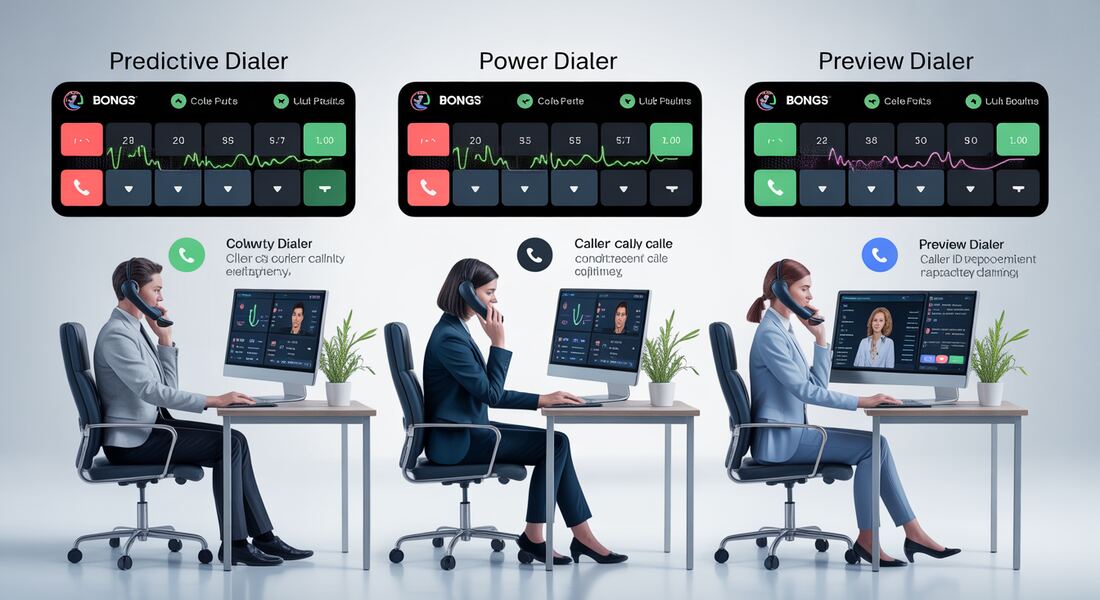
A predictive dialer is an automated system that dials multiple numbers at once and connects agents only to live calls, increasing contact rates for sales teams. A power dialer calls one number per agent at a steady pace, ensuring control and compliance. A preview dialer shows agent details before dialing, allowing personalized conversations.
Each mode serves a unique purpose: predictive maximizes efficiency, power balances speed with compliance, and preview prioritizes quality of customer engagement. In this guide, RockyDialer, as VICIdial experts, explains how businesses can choose the right dialer mode for productivity, compliance, and customer experience in 2025, while integrating brand-specific solutions like Bongs for caller ID reputation and capacity management.
What Are Auto Dialers?
An auto dialer is outbound software that automatically places phone calls and connects agents only when a live person answers. This technology reduces manual dialing, increases efficiency, and ensures agents spend more time in conversations rather than waiting for connections.
Modern auto dialers include several attributes: scalability for handling thousands of concurrent calls, compliance tools such as Do-Not-Call (DNC) scrubbing, and efficiency features like predictive dialing. For RockyDialer, the managed system known as Bongs adds caller ID reputation protection and tailored VICIdial hosting, aligning automation with regulatory standards.
Businesses use auto dialers to improve sales productivity, manage large outbound campaigns, and maintain customer experience quality while staying compliant with telemarketing regulations. Compared to manual dialing, auto dialers can raise talk time by up to 200%, providing measurable ROI for call centers.
What Is a Preview Dialer and When to Use It?
A preview dialer is outbound dialing software that connects one agent to one customer at a time, giving the agent access to customer details before the call begins. This one-to-one ratio ensures that every interaction is informed and personalized.
Preview dialers are best suited for industries where context, compliance, and trust are critical, such as healthcare services and B2B account management. Agents can review medical history, financial notes, or prior interactions before calling, which reduces errors and increases customer confidence.
Compared to a predictive dialer, which maximizes call volume by dialing multiple numbers simultaneously, a preview dialer focuses on conversation quality and regulatory safety. It prevents accidental non-compliance with Do-Not-Call (DNC) rules and improves customer experience in sensitive environments.
What Is a Power Dialer and When to Use It?
A power dialer is outbound dialing software that automatically dials one number at a time for each available agent in a sequential order. This approach balances efficiency with control, giving agents steady call pacing without the risk of dropped connections.
Power dialers are most effective in industries where consistency, compliance, and customer experience must align such as finance and insurance. By ensuring that every call is answered by a live agent, financial advisors and insurance agents can maintain professionalism, reduce abandonment rates, and build trust with clients.
Compared to a predictive dialer, which dials multiple numbers simultaneously, a power dialer maintains quality over volume, avoiding compliance risks like silent calls or excessive call attempts. This makes it suitable for regulated industries that require accurate records of every client interaction.
What Is a Predictive Dialer and When to Use It?
A predictive dialer is algorithm-driven software that dials multiple phone numbers at the same time and connects agents only when a live person answers. This automation reduces idle time, raises contact rates, and maximizes agent productivity.
Predictive dialers are especially valuable in telemarketing campaigns and large-scale research projects, where efficiency and speed are more important than individual personalization. By predicting agent availability, the system ensures that live calls are continuously fed to ready agents.
However, predictive dialing also comes with risks. If the algorithm miscalculates, calls may be answered without an agent available, leading to abandoned calls. In regulated industries, this can trigger compliance issues under laws such as the Telephone Consumer Protection Act (TCPA) and lead to penalties.
Progressive Dialer vs Predictive Dialer: Key Differences
A progressive dialer is outbound software that dials one contact automatically as soon as an agent becomes free and waits until the call is answered before moving to the next number. This ensures no call is placed without an agent available, reducing abandoned calls.
By contrast, a predictive dialer uses algorithms to dial multiple numbers simultaneously and routes only answered calls to agents. This maximizes efficiency but carries a higher risk of silent calls or compliance issues if the pacing algorithm miscalculates.
The key difference is that a progressive dialer prioritizes control and compliance by ensuring every call has an agent ready, while a predictive dialer prioritizes speed and efficiency by predicting agent availability.
Table: Progressive vs Predictive Dialer
| Feature | Progressive Dialer | Predictive Dialer |
| Dialing Method | Sequential (one call per free agent) | Algorithm-driven (multiple calls at once) |
| Agent Availability | Waits for agent before dialing | Predicts agent readiness in advance |
| Efficiency | Moderate efficiency, steady pacing | High efficiency, faster throughput |
| Compliance Risk | Low (minimal abandoned calls) | Higher (possible silent or abandoned calls) |
| Best Use Cases | Finance, insurance, compliance-heavy industries | Telemarketing, large-scale outbound campaigns |
| RockyDialer Integration | Bongs progressive mode with compliance safeguards | Bongs predictive mode with CID reputation support |
How to Choose the Right Dialer for Your Call Center?
To choose the right dialer, call centers should evaluate team size, compliance requirements, and the balance between personalization and call volume. Small and mid-sized businesses often prioritize compliance and agent control, while larger operations focus on throughput and automation.
For SMBs, a progressive or preview dialer may be the best fit because these modes ensure that each call is matched with an available agent, minimizing abandoned calls and protecting customer trust. This makes them effective in regulated industries such as finance and healthcare, where compliance and professionalism are critical.
For large-scale outbound campaigns, such as telemarketing or survey research, a predictive dialer provides maximum efficiency by using algorithms to predict agent availability and dialing multiple numbers at once. While this increases productivity, managers must monitor compliance risks and maintain accurate records.
RockyDialer offers a unique option with the Bongs hybrid mode, which combines predictive speed with progressive control. This allows managers to scale campaigns flexibly, adjusting dialer behavior to balance agent productivity with compliance safeguards.
Ultimately, the best dialer for a call center depends on business goals. If compliance and customer experience are priorities, progressive or preview modes are ideal. If efficiency and volume are the goal, predictive dialing works best. A hybrid mode gives call centers the flexibility to adapt across scenarios.
Comparison Table: Preview vs Power vs Predictive Dialers
Preview, power, and predictive dialers differ mainly in dialing speed, level of personalization, agent control, and compliance risk. Preview dialers emphasize personalization, power dialers balance efficiency with control, and predictive dialers maximize speed but require careful compliance monitoring.
Dialer Comparison Table
| Attribute | Preview Dialer | Power Dialer | Predictive Dialer |
| Dialing Speed | Slow – one record at a time | Moderate – sequential but automated | Fast – multiple numbers dialed simultaneously |
| Personalization | High – agent reviews record before dialing | Medium – limited review, steady pacing | Low – minimal review, focus on call volume |
| Agent Control | Strong – agent chooses timing | Balanced – system paces calls, agent accepts next call | Limited – algorithm controls pacing |
| Compliance Risk | Low – no abandoned calls | Moderate – manageable abandoned call risk | High – miscalculation can cause silent calls |
| Best Use Cases | B2B, healthcare, regulated industries | Finance, insurance, SMB campaigns | Telemarketing, research, large-scale outbound campaigns |
| RockyDialer Mode | Bongs preview mode with personalization safeguards | Bongs power mode with balanced pacing | Bongs predictive mode with compliance protection |
Compliance and Caller ID Reputation in Dialing
Outbound dialers must follow strict rules such as the TCPA in the U.S. and Ofcom in the U.K., while also managing Caller ID reputation to avoid being flagged as spam. Non-compliance risks heavy fines and damaged customer trust.
One of the most important safeguards is Do Not Call (DNC) scrubbing, which automatically removes restricted numbers from call lists. Without this, campaigns risk violations, legal penalties, and higher complaint rates.
Caller ID reputation is equally critical. Carriers and mobile devices often label numbers as “Scam Likely” if call volumes are too aggressive or if abandoned calls increase. A poor reputation reduces answer rates and can make outbound campaigns unsustainable.
RockyDialer’s Bongs compliance tools combine automated DNC scrubbing, real-time Caller ID monitoring, and STIR/SHAKEN alignment. These features protect call centers by ensuring legal compliance and preserving phone number credibility.
Maintaining compliance and reputation is not optional; it is the foundation of sustainable dialing. Managers who treat these safeguards as strategic assets can keep campaigns productive while protecting both brand and customer relationships.
RockyDialer’s Managed VICIdial Solution
RockyDialer provides a fully managed VICIdial platform that unifies preview, power, and predictive dialing into one secure and efficient system. This managed approach removes IT burdens, ensures compliance, and improves agent productivity for businesses of all sizes.
Unlike generic hosted dialers, the Bongs Dialer System is built on three core attributes:
- Efficiency – automated pacing tools maximize live connections.
- Security – encrypted SIP trunking and real-time Caller ID protection keep campaigns compliant.
- Analytics – managers gain actionable dashboards for agent monitoring, conversion tracking, and campaign optimization.
By integrating multiple dialing modes with managed hosting, RockyDialer enables call centers to scale without sacrificing reliability. Companies no longer need to maintain servers, troubleshoot downtime, or risk compliance gaps—the platform delivers an end-to-end solution backed by VICIdial expertise.
For call centers evaluating managed VICIdial services, the Bongs system represents not just software but a strategic business asset: a way to transform outbound communication into measurable sales growth, stronger compliance, and higher agent satisfaction.
People Also Ask About Dialers
What is the difference between a predictive and preview dialer?
A predictive dialer uses algorithms to call multiple numbers at once, while a preview dialer lets the agent review each record before dialing. Predictive maximizes speed, preview maximizes personalization.
What is the difference between a power and predictive dialer?
A power dialer calls numbers sequentially as soon as an agent is free, while a predictive dialer uses pacing algorithms to dial ahead of agent availability. Power balances efficiency and control; predictive favors speed.
Which dialer is best for a call center?
The best dialer depends on campaign goals: preview for compliance-heavy industries, power for insurance or finance, and predictive for large-scale outbound sales. RockyDialer’s Bongs system supports all three.