
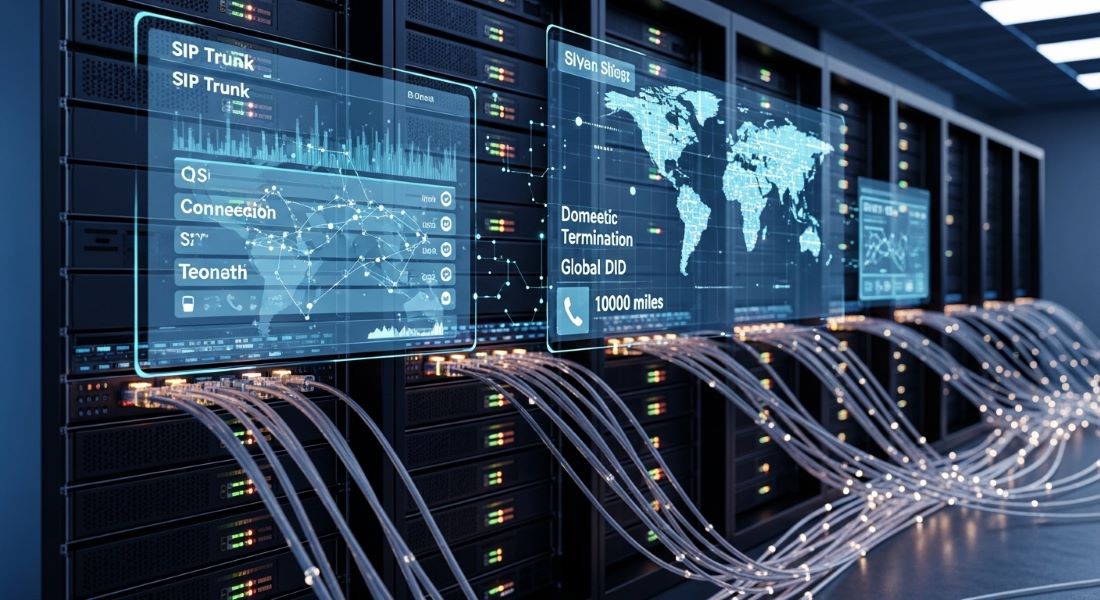
In today’s enterprise landscape the “geography of business” has outpaced the “geography of hardware.” A company based in Berlin may develop in Bangalore, sell in New York and serve customers across 50 countries. Traditional telephony built on copper wires and regional monopolies can no longer bridge that divide.
International SIP Trunking has become the backbone of global communication enabling businesses to treat the world as a single local network. By using Session Initiation Protocol (SIP) to deliver voice video and messaging over the internet companies gain scale, reduce costs and establish a seamless global presence.
This guide explores international voice connectivity from Domestic Termination mechanics to the strategic deployment of Global DID numbers.
The Anatomy of International SIP Trunking
What is a SIP Trunk?
To understand the “International” aspect, we first need to define a “trunk.” In traditional telephony, a trunk was a physical line (or bundle of lines) connecting a phone system to the network. A SIP trunk is the virtual equivalent, using the internet to connect your Private Branch Exchange (PBX) to the Public Switched Telephone Network (PSTN).
An International SIP Trunk is designed to carry calls across national borders. It is optimized for high-latency environments, ensuring that voice data traveling thousands of miles arrives in the correct order and without noticeable delay.
How It Works: The Journey of a Global Call
When a team member in your office dials an international number the call undergoes a complex digital journey:
- Initiation: Your IP PBX sends a “SIP INVITE” message over your internet connection.
- The International Gateway: The call hits your provider’s Point of Presence (PoP). Top tier providers maintain PoPs in major global hubs (e.g. Frankfurt Singapore New York) to minimize the distance data must travel.
- Transit: The voice data is packetized and sent across the global IP backbone.
- Domestic Termination: This is the critical “last mile.” Once the call reaches the destination country it must be “terminated” on the local PSTN so it can ring a standard mobile or landline phone.
- Completion: The recipient answers and a two way media stream (RTP) is established.
The Role of Domestic Termination and A Z Termination
Understanding Domestic Termination
In the context of international calling Domestic Termination is the process of delivering an inbound international call to a local subscriber within a specific country.
For a SIP provider to offer high quality service they must have strong interconnects with local carriers in every country they serve. If a provider has poor domestic termination partners users will experience:
- Dropped Calls: The hand off between the international network and the local network fails.
- CLI Issues: The Caller ID shows up as “Unknown” or “Private” which drastically reduces call answer rates.
- Poor Audio: High jitter or latency during the final leg of the call.
What is Wholesale A Z Termination?
The term A Z Termination refers to a provider’s ability to route calls to every possible destination globally from Afghanistan to Zimbabwe. For a business an A Z provider acts as a single point of contact. Instead of managing 20 different contracts with carriers in 20 different countries you use one International SIP Trunk that covers the entire alphabet of destinations.
Economic Impact: Cost Savings and ROI
Slashing International Calling Rates
The most immediate benefit of International SIP Trunking is the reduction in International Calling Rates. Traditional carriers often charge “long distance” premiums based on legacy billing models. SIP trunking treats voice as data.
By using Least Cost Routing (LCR) SIP providers can automatically choose the cheapest path for a call at any given millisecond. On average enterprises switching from traditional PRI lines to International SIP Trunks see a reduction in their monthly voice spend by 50% to 70%.
Eliminating Physical Infrastructure
With a global SIP solution you no longer need:
- Physical “gateways” in every country.
- Multiple local phone bills in different currencies.
- Maintenance contracts for on site hardware in satellite offices.
Building a Global Presence with DID Numbers
The Power of Localized Caller ID
Trust is the currency of communication. A customer in London is far more likely to answer a call from a +44 (020) number than a +1 (212) number.
International SIP Trunking allows for Localized Caller ID. Even if your call center is in the Philippines you can present a local number to your customer in the UK. This is achieved through DID (Direct Inward Dialing) Numbers Worldwide.
Virtual Presence Without the Real Estate
Businesses can purchase “Virtual DIDs” in over 100+ countries. This allows you to:
- Market your services as a “local” business in new regions.
- Provide toll free numbers for international customer support.
- Scale into new markets instantly without signing a single office lease.
Technical Excellence: Quality and Codecs
Call Quality Assurance for International Routes
Global calls are prone to “Latency” (delay) and “Jitter” (variation in packet arrival time). To combat this International SIP Trunks use sophisticated Call Quality Assurance protocols. This includes:
- Proactive Monitoring: Detecting a degraded route before the user notices and rerouting traffic.
- Redundancy: If a carrier in Brazil goes down the trunk automatically switches to a backup domestic termination partner.
Supported Codecs for Global Calls
Codecs (Coder Decoders) determine how the voice is compressed. The choice of codec is a balance between audio quality and bandwidth efficiency.
- G.711 (PCMU/PCMA): The “Gold Standard” for quality. It uses more bandwidth (80-100 Kbps) but provides uncompressed crystal clear audio.
- G.729: Optimized for bandwidth efficiency. It uses only about 30 Kbps making it ideal for regions with limited internet infrastructure.
- Opus: A modern versatile codec that adapts in real time to your internet speed providing high fidelity audio even on unstable connections.
Unified Communications Across Borders
International SIP Trunking is the engine behind Unified Communications (UC). It allows platforms like Microsoft Teams 3CX and Zoom Phone to connect to the “real world” PSTN.
By integrating your global SIP trunk with a UC platform your business gains:
- Cross Border Collaboration: Employees can call each other via 4 digit extensions regardless of which country they are in.
- Centralized Management: One web portal to manage thousands of numbers across the globe.
- Mobility: Employees can take their “office number” anywhere in the world via a mobile app or laptop.
Security and Compliance in Global Telephony
Combatting Toll Fraud
International calling is a prime target for hackers. “Toll Fraud” occurs when a system is compromised to make thousands of expensive international calls to “premium rate” numbers.
Reputable International SIP providers implement:
- IP Whitelisting: Only allowing calls from your specific office IP address.
- Rate Limiting: Automatically blocking traffic if call volume spikes unexpectedly.
- Encryption: Using TLS (Transport Layer Security) for signaling and SRTP (Secure Real time Transport Protocol) for voice data.
Navigating Global Regulations
Every country has its own telecom laws. Some countries (like the UAE or China) have strict regulations regarding VoIP. Others (like those in the EU) have rigorous data privacy laws (GDPR).
A professional SIP provider manages this complexity for you ensuring that your International SIP Trunking solution remains compliant with local “Know Your Customer” (KYC) and emergency calling (e911) requirements.
Conclusion
As we look toward 2026 and beyond the retirement of legacy PSTN networks is accelerating. The “Copper Sunset” means that businesses have no choice but to migrate to IP based voice.
International SIP Trunking is not just a tool for saving money; it is a strategic asset for growth. By combining the cost efficiency of the cloud with the reliability of high quality Domestic Termination businesses can truly operate without borders.
FAQs
What compliance considerations should I be aware of when using a predictive dialer?
Predictive dialers must adhere to regulations like the Telephone Consumer Protection Act (TCPA) and other local Do Not Call rules typically handled within quality hosted solutions to reduce legal risk.
Can predictive dialers integrate with CRM systems?
Yes most hosted predictive dialers support CRM integrations allowing real time data sync automated activity logging and better lead management across platforms. (Common feature for cloud dialer platforms).
Are predictive dialers suitable for small businesses?
Yes cloud based predictive dialers are scalable, often cost effective for SMBs and can improve outreach efficiency even for teams with limited resources.
What features should I look for in an affordable predictive dialer?
Look for features like intelligent dialing algorithms CRM integration compliance tools (DNC/TCPA) voicemail/answering machine detection and real time analytics to get strong ROI at a reasonable price.