
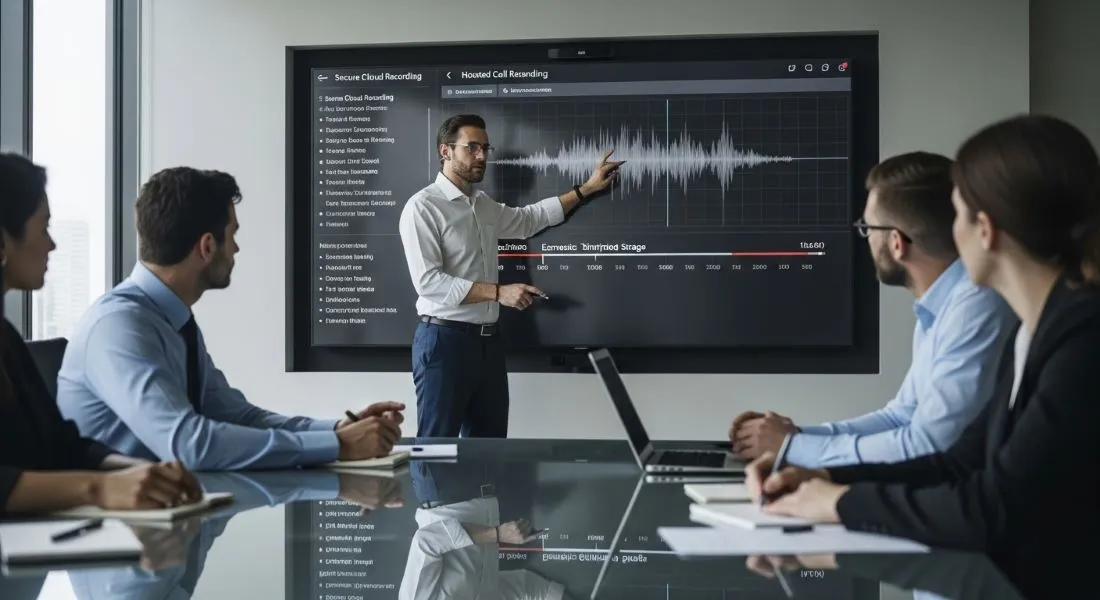
In the rapidly evolving landscape of corporate communication the transition from physical infrastructure to virtualized environments is no longer a luxury it is a survival tactic. Among the most critical components of this shift is Hosted Call Recording. Gone are the days of bulky on site servers tangled wires and expensive maintenance contracts.
Today businesses are leveraging the “Cloud Effect” to capture every customer interaction with precision security and scalability. This guide explores the synergy between hosted dialers and recording systems providing a roadmap for businesses looking to optimize their operations in 2026.
What is a Hosted Dialer with Call Recording?
To understand the power of this technology we must first define its core. A Hosted Dialer is a cloud based software solution used to automate the process of making outbound calls or managing inbound traffic. Unlike traditional systems that require a Physical Branch Exchange (PBX) located within your office, a hosted system lives in a secure third party data center.
Defining the Cloud Effect: No Hardware Total Control
The “Cloud Effect” refers to the decentralization of hardware. When you opt for a hosted service the provider manages the servers, the security patches and the storage architecture. For the business owner this means:
- Zero Footprint: You only need an internet connection and a laptop or IP phone.
- Instant Accessibility: Your data isn’t trapped in an office server; it is accessible via a secure web portal from anywhere in the world.
How Hosted Systems Replace Traditional On Premise PBX?
Traditional PBX systems were the gold standard for decades but they came with a “hardware ceiling.” If your server had 500GB of space you could only store a certain number of calls before deleting old ones or buying new hard drives. Hosted systems eliminate this ceiling by using Elastic Storage allowing you to scale your recording capacity infinitely as your business grows.
How Does a Hosted Dialer and Recording System Work?
The mechanics of cloud telephony are fascinating. It relies on a protocol known as SIP (Session Initiation Protocol) which converts voice into data packets that travel across the internet.
Automated Outbound Dialing vs. Manual Dialing
A hosted dialer uses algorithms to manage call volume:
- Power Dialers: Call one number after another for a single agent.
- Predictive Dialers: Use AI to predict when an agent will be free and dial multiple numbers simultaneously to minimize idle time.
In both scenarios the recording engine is integrated directly into the dialing stream ensuring that the moment a connection is made the data capture begins.
The Recording Trigger: Automatic vs. On Demand
One of the most flexible features of hosted systems is the ability to choose what to record:
- Always On Recording: Ideal for compliance heavy industries (Finance Healthcare) where 100% of interactions must be logged.
- On Demand Recording: Allows agents to trigger recording mid call using a star code (e.g. *8). This is useful for capturing specific verbal agreements or troubleshooting technical issues.
Centralized Storage: Accessing Call Logs via Admin Portal
Once the call ends the audio file is compressed (usually into .mp3 or .wav format) encrypted and sent to a Cloud Vault. Administrators can then log into a dashboard to filter calls by date agent name call duration or even customer sentiment.
Key Benefits of Using a Hosted Dialer for Your Business
Why are thousands of enterprises migrating to the cloud? The benefits are measurable in both productivity and profit.
Boosting Agent Productivity with Power Dialers
In a manual dialing environment an agent might spend 40% of their day just listening to dial tones or busy signals. A hosted dialer filters out these unproductive moments ensuring agents are only connected to live humans. When paired with recording managers can review these “live” moments to provide instant feedback significantly shortening the learning curve for new hires.
Cost Effectiveness: Eliminating CapEx
Traditional setups require Capital Expenditure (CapEx) the large upfront cost of buying equipment. Hosted solutions operate on an Operating Expenditure (OpEx) model. You pay a monthly subscription based on usage. This “Pay as you go” approach frees up cash flow for marketing and product development.
Scalability for Remote Teams
With the rise of the “Work from Home” era a hosted dialer is essential. An agent in London and an agent in Karachi can log into the same system use the same caller ID and have their calls recorded to the same central database as if they were sitting in the same room.
Advanced Features: Transforming Audio into Data
In 2026 call recording is no longer just about “listening” to audio; it’s about Big Data Analytics.
AI Powered Analysis: Sentiment and Summaries
Modern hosted systems use Natural Language Processing (NLP) to “read” the tone of a call.
- Sentiment Detection: The system can flag a call where a customer sounded “frustrated” or “angry” allowing a manager to intervene before the customer churns.
- Auto Summarization: Instead of listening to a 20 minute call AI provides a 3 sentence summary of the key takeaways.
CRM Integration: The Power of Context
By syncing your dialer with CRMs like Salesforce or HubSpot every recording is automatically attached to the customer’s profile. When a customer calls back the agent can see their entire history including previous recordings providing a “360 degree view” of the relationship.
Call Whisper and Call Barge
These are essential for Quality Assurance (QA):
- Call Whisper: A manager can speak to the agent during a live call without the customer hearing providing real time coaching.
- Call Barge: If a call is going south the manager can “barge” in and take over the conversation entirely.
Compliance Legal and Security Standards
This is the most critical section for any business owner. Recording a call without following the law can lead to massive fines.
Adhering to GDPR PCI DSS and HIPAA
- GDPR (Europe): Requires that you have a “legitimate interest” to record and that callers are informed.
- PCI DSS (Payments): If a customer reads their credit card number over the phone the recording system must automatically “mask” or “mute” that portion of the audio to prevent data theft.
- HIPAA (Healthcare): Ensures that patient health information (PHI) is stored in an ultra secure encrypted environment.
Data Sovereignty and Encryption
Where does your data live? Many countries require that data collected from their citizens stay within their borders. Top tier hosted providers offer Regional Data Residency allowing you to choose a data center in the US EU or Asia to stay compliant with local laws.
Hosted Dialer vs. Traditional Dialer: Comparison Table
| Feature | Hosted Dialer (Cloud) | Traditional On Premise |
| Initial Cost | Low (Subscription) | High (Server Purchase) |
| Setup Time | Hours / Days | Weeks / Months |
| Maintenance | Automatic (Provider) | Manual (In house IT) |
| Reliability | 99.9% Uptime (Redundant) | High Risk of Hardware Failure |
| Updates | Instant / New Features | Requires Physical Upgrades |
Selecting the Best Hosted Dialer Provider
When evaluating vendors don’t just look at the price. Look at the API Support. Can their system talk to your existing software? Look at their Uptime Guarantee. If their cloud goes down your sales team stops working. Finally check their Latency. High quality voice requires low latency to avoid “robotic” voices or delays during the conversation.
Conclusion
Hosted Call Recording and Dialer solutions are the backbone of modern business communication. By moving to the cloud you gain more than just a recording tool you gain a suite of AI driven insights, iron clad security and the flexibility to grow your business without boundaries.
FAQs
Is it possible to record calls secretly?
Legally no. In most jurisdictions at least one party (and often both) must be aware of the recording. Always enable an automated “This call is recorded” greeting.
Does call recording slow down my internet?
Modern codecs like G.711 or G.729 are highly efficient. A standard call uses very little bandwidth but we recommend a dedicated fiber connection for call centers with over 10 agents.
How long can I store recordings?
Most hosted providers offer retention periods ranging from 30 days to 7 years depending on your industry’s compliance needs.