
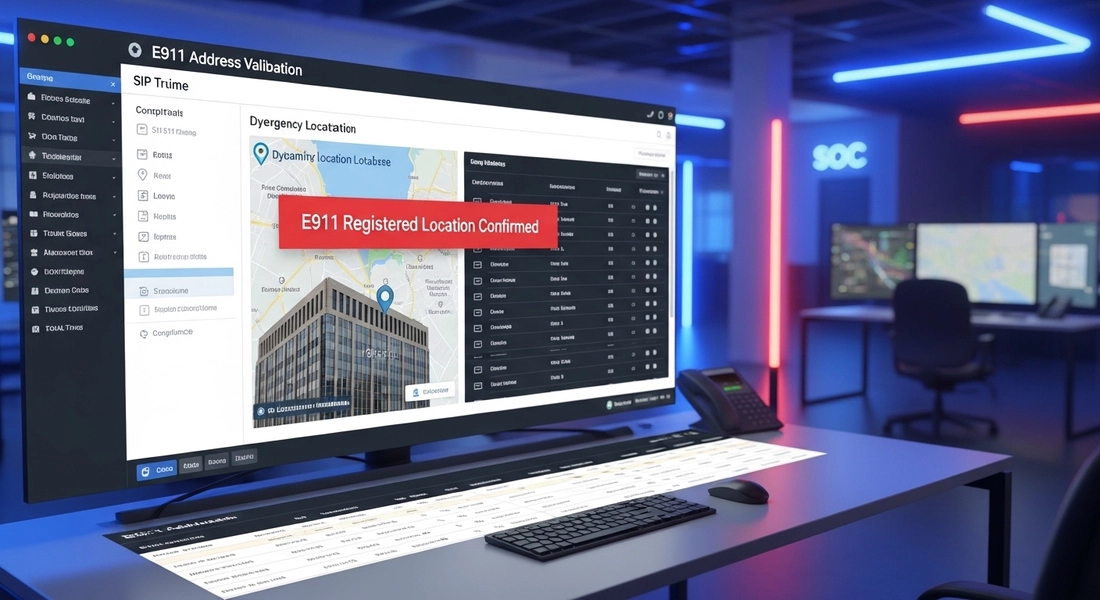
The transition from traditional Public Switched Telephone Networks (PSTN) to Session Initiation Protocol (SIP) trunking has revolutionized business communication. However this shift from “fixed wire” to “virtual cloud” connectivity has created a significant safety gap: the 911 location problem.
In a world where your office phone could be a desk set in Chicago or a laptop in a London coffee shop how do first responders find you during a crisis? This is where E911 (Enhanced 911) becomes the backbone of corporate responsibility.
In this guide we will explore the technical legal and operational nuances of E911 for SIP Trunking to ensure your business stays compliant and more importantly keeps its people safe.
Defining E911 in the Age of SIP
To understand E911 we must first look at the limitations of “Basic 911.”
Basic 911 vs. Enhanced 911
In the early days of telephony every phone was tied to a physical copper pair that terminated at a specific street address. When you dialed 9 1 1 the local exchange knew exactly which house the signal originated from.
SIP Trunking changed the rules. SIP sends voice packets over the internet. The “location” is no longer defined by a wire but by an IP address or a registered user profile.
- Basic 911: Simply routes a call to a Public Safety Answering Point (PSAP). It does not automatically provide the caller’s location or call back number.
- E911 (Enhanced 911): Automatically delivers the caller’s Automatic Number Identification (ANI) and Automatic Location Identification (ALI) to the dispatcher’s screen.
The Concept of “Dispatchable Location”
Under modern regulations a street address is no longer enough. If your business occupies a ten story building a street address only gets the ambulance to the front door. Dispatchable Location refers to the specific room floor or suite number where the emergency is occurring. For SIP trunking providing this granular data is the primary goal of E911.
The Technical Architecture of E911 Routing
How does a digital packet of data turn into a location on a dispatcher’s map? The process involves several moving parts.
The SIP INVITE and Call Headers
When a user dials 911 the SIP trunk sends an INVITE message. This message contains the caller’s DID (Direct Inward Dialing) number. The E911 system uses this DID as a key to look up the registered address in a database.
The Role of the VPC (VoIP Positioning Center)
The VPC is a specialized entity that sits between the SIP provider and the emergency network. Its job is to:
- Receive the call from the SIP trunk.
- Query the ERDB (Emergency Routing Database).
- Determine the correct PSAP based on the caller’s location.
- Route the call over dedicated emergency lines.
Domestic Termination and Reliability
The reliability of your emergency system is only as good as the network carrying the traffic. This is where Domestic Termination quality becomes critical. In the telecommunications world “termination” refers to the completion of a call from one provider to another.
High quality Domestic Termination ensures that when a 911 call is placed it is prioritized and routed through local high availability gateways rather than being bounced through low quality international routes. For E911 your SIP provider must have robust domestic paths to ensure zero latency delivery to the PSAP.
Managing the “Nomadic” User Challenge
The greatest challenge for E911 in SIP trunking is the remote worker. If an employee takes their IP phone home the system might still think they are at the headquarters.
Dynamic Location Routing
To solve this advanced SIP providers offer Dynamic Location Routing. This technology allows the device to update its location based on the network it is connected to (e.g. WiFi BSSID or IP subnet). If the device cannot determine its location automatically many systems will prompt the user to “Update Emergency Address” upon login.
Softphones and Mobile Clients
For workers using apps on their laptops E911 compliance requires the software to be aware of the user’s physical presence. This is often handled through a “Registered Address” portal where the user must manually confirm their location if they move to a new site.
Cost Management and the “933” Test
Setting up E911 involves costs but the cost of not setting it up is much higher.
The Unregistered Call Penalty
Most major SIP providers (like Twilio or Lumen) charge a significant fee often $75 or more for every 911 call made from a number that does not have a registered emergency address. This fee exists because the provider has to manually route the call to a national emergency call center where an operator must verbally ask for the location before transferring the call.
Validating Addresses with MSAG
Before an address can be used for E911 it must be validated against the MSAG (Master Street Address Guide). This is a database used by local emergency services to ensure that an address actually exists within their jurisdiction. If your address isn’t “MSAG valid” your E911 registration will fail.
The Importance of 933 Testing
You should never dial 911 just to “test” if your system works. This ties up emergency lines and can lead to fines. Instead SIP providers offer 933 Testing.
When you dial 9 3 3:
- An automated voice reads back the phone number you are calling from.
- It confirms if the number is correctly registered for E911.
- It reads back the registered address on file.
Implementation Checklist for Businesses
To ensure you are fully protected and compliant follow these steps:
- Audit Your DIDs: Ensure every physical site has at least one unique DID registered for E911.
- Check Your Dial Plan: Verify that “9” or any other prefix is not required to reach 911.
- Enable Notifications: Set up email or SMS alerts for your office manager whenever 911 is dialed.
- Partner with a Quality Provider: Ensure your SIP provider offers Tier 1 Domestic Termination to guarantee call path stability.
- Educate Remote Staff: Make sure employees know they must update their location when working from a new home or satellite office.
- Perform Regular 933 Tests: Schedule a quarterly check of all primary outbound lines.
Conclusion
E911 for SIP Trunking is more than a technical configuration or a box to tick for the FCC. It is a critical component of a modern safety strategy. By understanding the intersection of legal requirements like RAY BAUM’S Act and the technical necessity of precise Domestic Termination and MSAG validation you can build a communication system that isn’t just efficient it’s life saving.
In an emergency every second counts. Don’t let your SIP trunk be the reason help is delayed.
FAQ
Can I use one E911 address for my entire company?
Only if everyone is in a single small office. If you have multiple floors or buildings RAY BAUM’S Act requires unique “dispatchable locations” for each area.
Does E911 work if the internet goes down?
No. Since SIP relies on the internet if your connection is down your SIP phones won’t work. It is always recommended to have a cellular backup or a single analog POTS line for emergencies.
What is the role of Domestic Termination in emergency calls?
Domestic Termination ensures the call stays within high quality local networks preventing delays or routing errors that could occur on cheaper international or “grey” routes.