
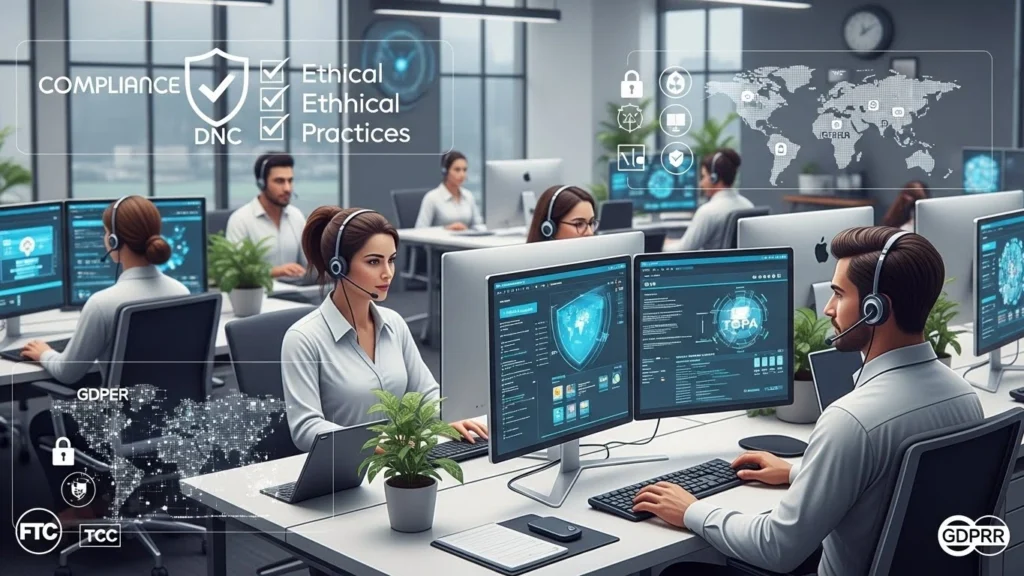
Do Not Call (DNC) compliance is a regulatory framework that governs how businesses using hosted dialers can legally place outbound calls. It protects consumers from unwanted telemarketing while guiding organizations to follow lawful, transparent, and ethical practices.
In the United States, the Federal Trade Commission (FTC) and the Federal Communications Commission (FCC) enforce rules under the Telephone Consumer Protection Act (TCPA). These laws set limits on when, how, and to whom outbound calls may be placed. For businesses operating globally, compliance also extends to international standards such as the General Data Protection Regulation (GDPR) in the European Union, which regulates data privacy and consent.
Failure to comply with these frameworks can result in severe fines, reputational damage, and restricted business operations. For example, violating TCPA rules can lead to penalties of up to $1,500 per call, while GDPR non-compliance can carry multi-million-euro sanctions.
For companies using hosted dialers, compliance is not just about avoiding penalties; it is a cornerstone of ethical outbound communication. Following DNC regulations builds trust, improves call answer rates, and ensures that outreach efforts are both effective and consumer-friendly.
What Is Outbound Call Compliance?
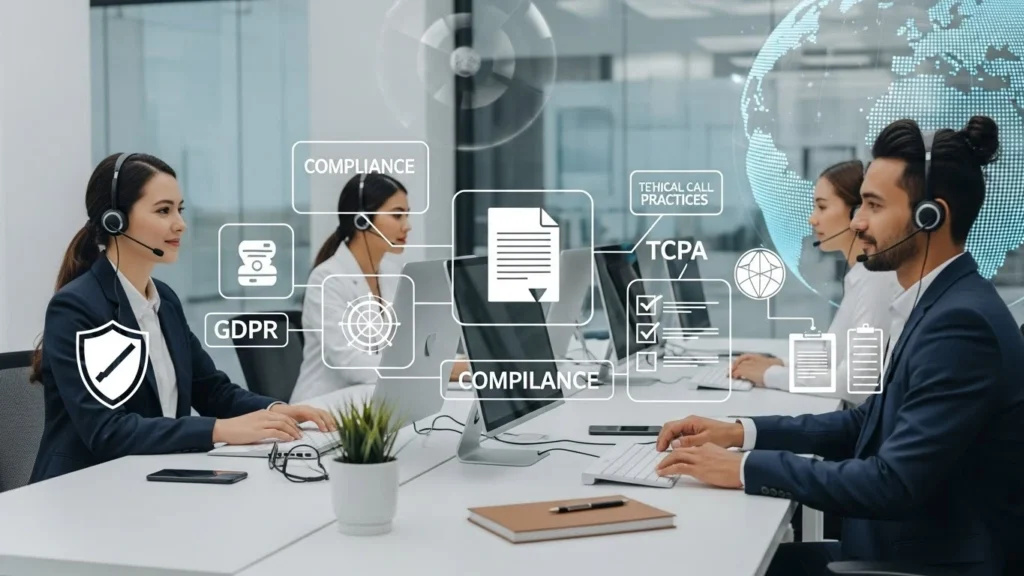
Outbound call compliance refers to the set of legal, technical, and ethical rules that organizations must follow when making calls to consumers or businesses. It ensures that telemarketing, customer support, and sales outreach activities are conducted in line with regulations that protect recipients’ privacy and rights.
In the United States, compliance is shaped by the Telephone Consumer Protection Act (TCPA) and the Telemarketing Sales Rule (TSR), which regulate call frequency, permissible calling hours, and requirements for honoring opt-out requests. In the European Union, the General Data Protection Regulation (GDPR) further strengthens consumer protections by requiring explicit consent for processing personal data and restricting cross-border data use.
For B2C (business-to-consumer) calling, compliance focuses on protecting individual consumers from unwanted intrusions, robocalls, and deceptive practices. By contrast, B2B (business-to-business) calling regulations tend to be less restrictive but still emphasize accuracy, truthful representation, and honoring opt-out preferences.
Ethical outbound call compliance goes beyond avoiding fines. It involves transparent communication, respecting consent, and training agents to prioritize customer experience. Organizations that embed compliance into their calling strategies benefit from higher trust, improved conversion rates, and stronger long-term relationships with prospects.
What Is TCPA Compliance with DNC?
The Telephone Consumer Protection Act (TCPA) is a U.S. federal law that regulates how organizations can place outbound calls, especially when using automated dialing systems. TCPA compliance with the Do Not Call (DNC) registry ensures that businesses respect consumer privacy and avoid prohibited practices such as calling restricted numbers or delivering unauthorized prerecorded messages.
Under TCPA, companies must obtain prior express consent before contacting consumers through robocalls or text messages. The law also sets clear time restrictions, typically limiting calls to between 8 a.m. and 9 p.m. (local time of the recipient). These rules apply across industries, from telemarketing firms to customer support centers using hosted dialers.
Hosted dialer platforms integrate TCPA compliance by embedding features such as automatic DNC list scrubbing, consent management, and call scheduling controls. These safeguards ensure that agents only contact numbers cleared for outreach and that customers’ opt-out requests are honored immediately.
Non-compliance with TCPA can lead to severe financial penalties. Fines range from $500 per violation for unintentional breaches to $1,500 per call for willful violations. In some cases, courts have approved class-action settlements that exceed $40,000 per incident, making compliance not just a legal obligation but a critical business safeguard.
For organizations relying on outbound campaigns, TCPA compliance with DNC is both a legal and ethical standard. It builds trust with consumers, protects brand reputation, and ensures that outreach strategies remain sustainable.
In the next section, we will examine how hosted dialers operationalize compliance through real-world configurations and best practices, bridging legal frameworks into practical execution.
What Is DNC in Call Centers?
The Do Not Call (DNC) list is a regulatory safeguard that restricts call centers from contacting phone numbers that have opted out of telemarketing. In the U.S., this framework is enforced through the National Do Not Call Registry, managed by the Federal Trade Commission (FTC), alongside additional state-level lists that impose their own rules and time limits.
For call centers, DNC compliance means identifying and removing (“scrubbing”) numbers that appear on these registries before dialing. Consumer phone numbers listed on the National Registry are strictly off-limits for promotional calls unless the company has documented consent or an existing business relationship. Business phone numbers, however, may be exempt in certain cases depending on jurisdiction, though accuracy in classification is critical to avoid violations.
Failure to respect DNC rules can lead to substantial fines and lawsuits. For example, the FTC has issued penalties exceeding $43,000 per call, and companies have faced multi-million-dollar settlements for ignoring opt-out requests. These legal consequences highlight why proactive scrubbing technology and compliance training are essential for call centers.
In summary, DNC in call centers is not only a legal requirement but also a trust-building practice. By respecting consumer preferences, organizations reduce legal exposure and improve customer perception. In the next section, we will explore how DNC compliance connects with broader outbound call regulations, ensuring call centers align both ethically and legally with industry standards.
Why DNC Compliance Matters for Businesses
DNC compliance matters for businesses because it safeguards consumer privacy, prevents costly legal violations, and strengthens long-term trust with customers. By following Do Not Call regulations, organizations protect both their reputation and their return on investment (ROI) from outbound calling campaigns.
From a legal perspective, DNC compliance shields businesses from severe penalties. Regulatory agencies such as the Federal Trade Commission (FTC) and Federal Communications Commission (FCC) can impose fines of up to $43,792 per call for willful violations. Beyond financial damage, lawsuits and regulatory actions can harm brand credibility and disrupt call center operations.
From an ethical perspective, respecting DNC rules demonstrates a commitment to transparent, consumer-first communication. Call centers that honor opt-out requests and limit intrusive outreach create a more positive customer experience, which in turn increases loyalty and reduces churn.
Compliance also delivers measurable business benefits. Companies that embed DNC compliance into their outbound strategies enjoy higher answer rates, improved conversion ratios, and stronger customer relationships. In effect, protecting consumer rights is not just a legal safeguard but a driver of sustainable ROI.
How to Scrub Numbers Against the DNC List
Scrubbing numbers against the Do Not Call (DNC) list is the process of removing phone numbers that are legally restricted from outbound calling campaigns. This step is essential to ensure that call centers comply with regulations, protect consumer privacy, and avoid heavy fines.
The scrubbing process involves several key steps:
- Obtain the official DNC list – Businesses must first register and download the latest data from the National Do Not Call Registry or state-level lists, depending on where they operate.
- Integrate with compliance software – Use DNC scrubbing software or hosted dialer tools to automatically compare campaign lists against the registry. Manual scrubbing is risky because it increases the chance of human error and missed updates.
- Update regularly – The DNC registry is updated continuously, so scrubbing should be performed before every campaign launch. Automated solutions allow daily syncing to ensure accuracy.
- Honor opt-out requests immediately – Beyond the national list, call centers must maintain an internal DNC list for consumers who request not to be contacted. Compliance tools should record and enforce these preferences in real time.
By following these steps, businesses reduce the risk of calling restricted numbers and strengthen trust with customers. Automation not only saves time but also creates a reliable compliance framework that scales with outbound call operations.
Step-by-Step Compliance Plan for Hosted Dialers in 2025
A compliance plan for hosted dialers in 2025 must balance legal requirements, ethical calling practices, and evolving data privacy expectations. Regulators are tightening enforcement under the Telephone Consumer Protection Act (TCPA), the Telemarketing Sales Rule (TSR), and the General Data Protection Regulation (GDPR), making structured compliance planning essential.
The following step-by-step framework helps call centers and enterprises align with 2025 compliance standards:
- Scrub campaign lists against the National and state DNC registries
– Every outbound list should be matched against the Do Not Call (DNC) registry before dialing. Automated scrubbing tools reduce risk compared to manual filtering and ensure accuracy at scale. - Maintain internal suppression lists for at least five years
– Beyond national lists, companies must keep an internal DNC list that logs opt-out requests. Regulations typically require records to be retained for five years, ensuring consumer preferences are respected over time. - Honor time restrictions on outbound calling
– Hosted dialers should enforce restrictions such as the 8 a.m. to 9 p.m. local time window. Advanced scheduling features help prevent after-hours violations, which can trigger fines. - Record and store consent logs
– Consent management is central to compliance. Dialers should track express written consent for automated calls and text messages, with timestamped logs for auditing purposes. - Apply GDPR-compliant data handling
– For businesses operating in or contacting the European Union, hosted dialers must integrate GDPR principles. This includes lawful basis for processing, secure data storage, and honoring the “right to be forgotten.”
- Common Risks of Non-Compliance (TCPA, FCC, FTC)
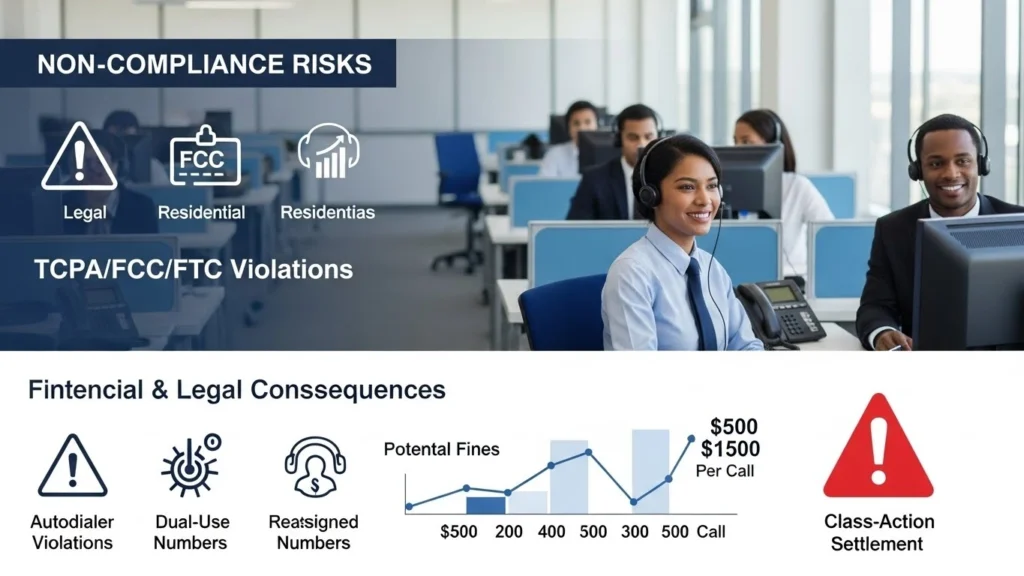
- Non-compliance with outbound calling laws such as the Telephone Consumer Protection Act (TCPA), the Federal Communications Commission (FCC) regulations, and the Federal Trade Commission (FTC) rules exposes businesses to severe legal, financial, and reputational risks.
- One of the biggest risks involves the use of autodialers without proper consent. Under TCPA, dialing mobile phones or residential numbers using automated technology without prior express consent can trigger penalties of $500 to $1,500 per call, depending on whether the violation is deemed negligent or willful.
- Another compliance risk arises from dual-use mobile phones, where a number is used for both business and personal purposes. Call centers that mistakenly treat such numbers as exempt may face lawsuits if the consumer has registered the number on the DNC list or withdrawn consent.
- Reassigned numbers also pose a growing challenge. When ownership of a phone number changes hands, calling the new subscriber without fresh consent may constitute a violation. To address this, the FCC has developed a Reassigned Numbers Database, yet failure to check it still exposes businesses to significant liability.
- Beyond financial penalties, lawsuits and regulatory actions can damage brand credibility, reduce answer rates, and erode customer trust. High-profile TCPA class actions have resulted in multi-million-dollar settlements, illustrating how compliance lapses create both legal and operational consequences.
Building Ethical and Legal Outbound Strategies
Building ethical and legal outbound strategies is more than just a compliance requirement—it is a competitive advantage for call centers and businesses. By integrating DNC and TCPA compliance into every outbound campaign, organizations safeguard against fines, protect their reputation, and establish trust with consumers.
Ethical compliance also strengthens long-term revenue growth. Customers are more likely to engage with brands that respect their privacy, honor consent, and communicate transparently. This trust translates into higher answer rates, improved conversions, and sustainable customer relationships.
In conclusion, compliance is not only about avoiding penalties it is about building trust, driving revenue, and enabling scalable growth in a regulated environment. Businesses that prioritize ethical outbound calling today position themselves as leaders in customer-first communication tomorrow.
FAQ on DNC & TCPA Compliance
- What is TCPA compliance with DNC?
TCPA compliance with DNC means following the Telephone Consumer Protection Act (TCPA) while respecting the Do Not Call (DNC) registry. This requires businesses to obtain prior consent before using autodialers, honor consumer opt-out requests, and avoid calling numbers listed on national or state DNC lists.
- What is compliance in a call center?
Call center compliance refers to following legal, ethical, and operational rules that regulate outbound calls. This includes adhering to TCPA and DNC rules, honoring calling time restrictions, maintaining suppression lists, recording consent, and protecting consumer data under frameworks such as GDPR.
- What happens if you call a number on the DNC list?
Calling a number on the DNC list without consent can result in legal violations, fines, and lawsuits. The FTC and FCC can impose penalties of up to $43,792 per call for willful violations, and repeated infractions may trigger class-action lawsuits or loss of business credibility.
- What are the fines for violating TCPA or DNC rules?
Penalties under TCPA and DNC regulations typically range from $500 per call for negligent violations to $1,500 per call for willful violations. Large-scale cases have resulted in multi-million-dollar settlements, making compliance both a legal necessity and a financial safeguard.