
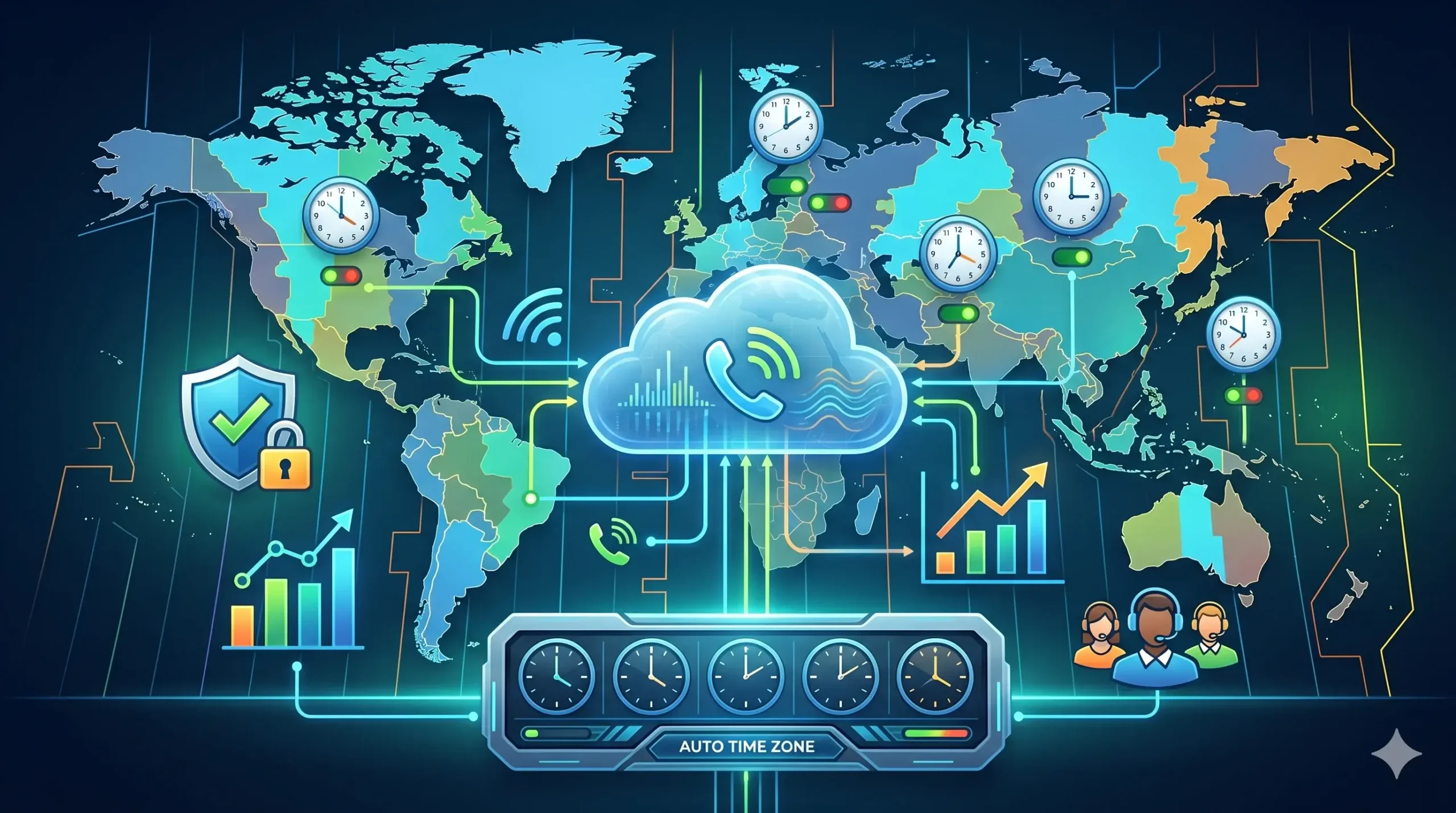
Running outbound campaigns without time zone intelligence is like driving with no map. You might reach some prospects, but you will also call people at inconvenient hours, trigger compliance violations, and watch your contact rates fall. For teams relying on a hosted dialer solution, built-in time zone management is not a bonus feature. It is a core operational requirement.
This guide breaks down how time zone automation works inside modern hosted dialers, which legal frameworks govern calling hours, and how to configure your campaigns for maximum reach with minimum risk.
Why Time Zone Management Matters in Outbound Calling
Every prospect on your list lives in a specific time zone, and that time zone directly affects whether they answer. Calling someone at 7:00 AM their local time almost guarantees a hang-up or a complaint. Calling them at 10:30 AM in their window gives you a genuine shot at a conversation.
Two critical factors make time zone awareness non-negotiable for outbound teams: contact rate optimization and legal compliance. Both carry serious consequences if ignored.
From a compliance standpoint, the Telephone Consumer Protection Act (TCPA) restricts outbound calls to between 8:00 AM and 9:00 PM in the called party’s local time, not your office time. If your team is in New York and your prospects are in Los Angeles, you cannot start dialing them at 8:00 AM Eastern because it is only 5:00 AM Pacific. Violations can result in fines of $500 to $1,500 per call, and class-action exposure makes this risk multiplied.
How Hosted Dialers Automate Time Zone Adjustments
This is where modern hosted dialer technology earns its value. Instead of relying on agents or campaign managers to calculate time zones manually, a well-configured hosted dialer maps each phone number’s area code or geographic data to a corresponding time zone automatically.
Here is how the process typically works inside the system:
• The dialer reads the prospect’s phone number (and sometimes ZIP code or state data) from your lead list.
• It maps that number to a local time zone using an internal geographic database.
• It checks whether that time zone currently falls within your configured calling hours.
• If it does, the lead enters the active calling queue. If it does not, the system holds it and reattempts during the next compliant window.
This entire process runs automatically across all your campaigns, which reduces manual oversight and eliminates the risk of accidental out-of-hours calls at scale.
Setting Campaign Calling Hours the Right Way
Most hosted dialers allow calling hours to be defined at the campaign level. This means you can run a national campaign with a single hour configuration while the system applies it per time zone behind the scenes.
Best practices for campaign hour setup:
• Default to the TCPA-compliant window of 8:00 AM to 9:00 PM local time for all consumer campaigns.
• For B2B outreach, tighten the window to 9:00 AM to 5:00 PM to align with business operating hours.
• For international campaigns, research local calling regulations before finalizing hours. Countries like Germany, Australia, and the UK each have distinct rules.
• Build in a 5 to 10 minute buffer before and after each cutoff to account for system processing time.
A dialer that applies one flat time zone window to your entire lead list puts every record outside that zone at legal and reputational risk. Per-lead time zone resolution is the only reliable method for mixed or national lists.
Complying with Calling Hour Curfew Laws
TCPA is the federal baseline in the United States, but it is not the only rule in play. Some states have stricter or additional requirements that outbound teams must account for. Pair your time zone configuration with proper DNC compliance management to address both dimensions of outbound calling law.
Notable state-level considerations include:
• Florida: Known for aggressive TCPA enforcement. Proper documentation of call timing and consent is critical.
• California: Subject to both TCPA and California Consumer Privacy Act (CCPA) requirements, making consent and timing equally important.
• Indiana: Restricts calls to 8:00 AM to 9:00 PM local time with additional frequency rules.
For teams running international outbound campaigns, time zone restrictions intersect with country-level privacy and telemarketing laws. Never assume federal US rules transfer to other markets.
Optimal Calling Windows by Time Zone
The table below summarizes the key time zones, their legal calling windows, and the peak hours that consistently produce the highest live contact rates across outbound campaigns:
| Time Zone | Key Regions | TCPA / Legal Window | Peak Calling Hours |
| Eastern (ET) | New York, Florida, Georgia | 8:00 AM to 9:00 PM | 10:00 AM to 12:00 PM / 4:00 PM to 6:00 PM |
| Central (CT) | Texas, Illinois, Minnesota | 8:00 AM to 9:00 PM | 10:00 AM to 12:00 PM / 4:00 PM to 6:00 PM |
| Mountain (MT) | Colorado, Arizona, Utah | 8:00 AM to 9:00 PM | 10:00 AM to 12:00 PM / 3:00 PM to 5:00 PM |
| Pacific (PT) | California, Washington, Oregon | 8:00 AM to 9:00 PM | 10:00 AM to 12:00 PM / 4:00 PM to 6:00 PM |
| GMT / BST | United Kingdom | 9:00 AM to 8:00 PM | 10:00 AM to 12:00 PM / 2:00 PM to 5:00 PM |
| CET / CEST | Germany, France, Italy | 9:00 AM to 8:00 PM | 10:00 AM to 12:00 PM / 2:00 PM to 5:00 PM |
| AEST / AEDT | Australia (East) | 9:00 AM to 8:30 PM | 10:00 AM to 12:00 PM / 3:00 PM to 5:00 PM |
Note: Legal windows above reflect TCPA standards for US time zones and general best practice for international regions. Always verify local regulations before launching cross-border campaigns.
Benefits of Time Zone Intelligence for Global Teams
For organizations operating across multiple regions or countries, time zone automation delivers measurable advantages in three areas.
Higher Contact Rates
Calls made during the correct local window consistently outperform off-hours attempts. Data from multiple outbound teams shows that the 10:00 AM to 12:00 PM window and the 4:00 PM to 6:00 PM window generate the highest answer rates, regardless of industry or geography.
Improved Agent Efficiency
When leads outside the calling window are automatically held back, agents work exclusively on dialable numbers. This reduces wasted attempts and keeps agent talk time high throughout the shift, directly improving campaign ROI.
Protected Caller ID Reputation
Calling at appropriate hours reduces the volume of “too early” or “too late” complaints. Fewer complaints mean fewer spam flags. This is why pairing time zone management with caller ID reputation monitoring makes sense for any high-volume outbound operation.
Scalability for International Campaigns
If your outbound strategy extends beyond domestic markets, time zone automation becomes even more critical. Combining a time-zone-aware dialer with global SIP trunking coverage ensures your campaigns reach international prospects compliantly and efficiently, without needing separate tools or manual scheduling.
Key Takeaways
• TCPA restricts outbound calls to 8:00 AM to 9:00 PM in the called party’s local time. This is a legal requirement, not a guideline.
• Hosted dialers with built-in time zone automation eliminate manual calculation errors and protect campaigns at scale.
• Campaign calling hours should default to the called party’s local time, never your office time zone.
• State-level and international regulations may impose stricter rules than the federal TCPA baseline.
• Combining time zone management with DNC scrubbing and CID reputation monitoring creates a complete outbound compliance framework.
Frequently Asked Questions
Q1. Can a hosted dialer detect a prospect’s time zone without ZIP code data?
Yes. Most hosted dialers map time zones using the area code from the phone number itself, so even lead records without ZIP code data are covered automatically.
Q2. Does time zone management apply to outbound SMS campaigns as well?
Yes. TCPA calling hour restrictions apply to text messages as well as voice calls. The same local time windows of 8:00 AM to 9:00 PM must be respected for SMS outreach.
Q3. What happens if a call attempt hits exactly at the curfew cutoff, like 9:00 PM?
Best practice is to stop dialing 5 to 10 minutes before the cutoff. Boundary-case timing creates legal exposure and most compliance teams recommend a safe buffer.
Q4. Can I set different calling hours for separate campaigns on the same dialer?
Yes. Hosted dialers support campaign-level hour settings, so a B2B campaign and a consumer campaign can run different windows simultaneously on the same platform.
Q5. Are TCPA time restrictions the same across all US states?
No. Federal TCPA sets the minimum standard, but states like Florida, California, and Indiana have stricter requirements. Always check state-level rules before launching.