
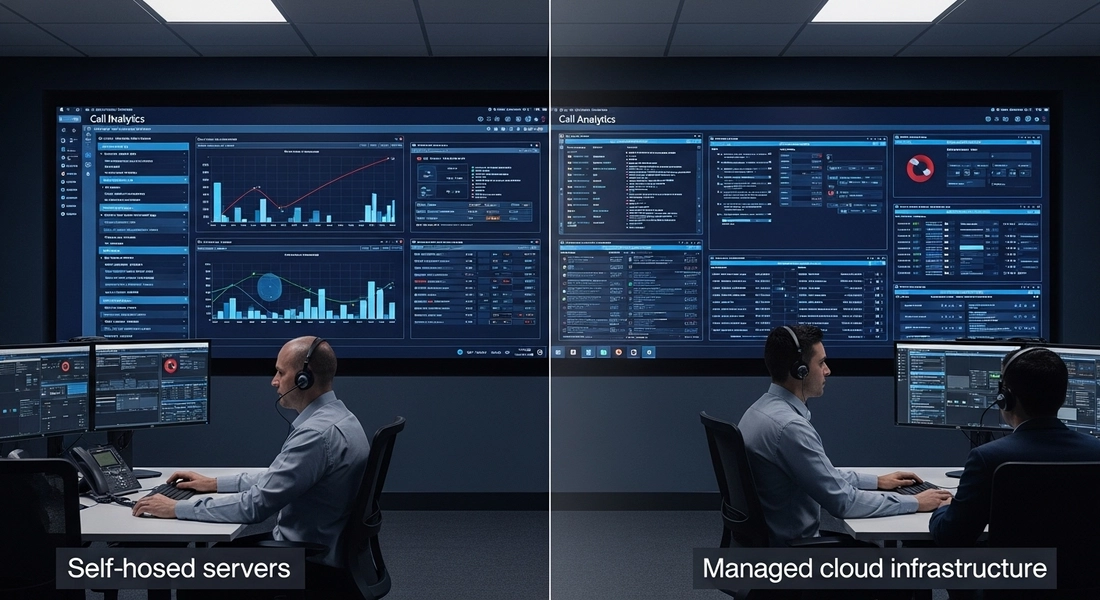
In 2026 the telecommunications landscape has shifted. While proprietary “black box” dialers have become more expensive and restrictive, Open Source Dialer Software has evolved into an enterprise grade powerhouse.
However for many businesses the word “free” is a paradox. While the software itself costs nothing to download the infrastructure maintenance and expert level configuration required to run it can create a massive hidden “Technical Debt.”
This article serves as a strategic roadmap for decision makers who are caught between the desire for total flexibility and the need for operational uptime.
Understanding VICIdial Asterisk and FreePBX
To navigate this topic one must understand the core entities that define the open source telephony ecosystem.
VICIdial: The Industry Standard
VICIdial is the most popular open source contact center suite in the world. It is built to interact with the Asterisk Open Source PBX to act as a complete inbound/outbound solution. It supports predictive dialing power dialing and manual dialing modes.
Asterisk: The Engine
Asterisk is the underlying framework. Think of it as the “engine” of the car while VICIdial is the “dashboard” and “controls.” Asterisk handles the SIP protocols call routing and media processing.
FreePBX: The GUI Specialist
While VICIdial is built for high volume call centers, FreePBX is often used for general office communications. For technical users integrating FreePBX with a dialer can provide a unified communication experience.
The “Chris Maxwell” Persona: Why Technical Skill Level Matters
We’ve identified our primary ICP as Chris Maxwell—a CTO or Lead DevOps Engineer who is “Technically Inclined.” Chris isn’t looking for a basic “how to” guide; he’s looking for a justification of Managed Services vs. Self Hosting.
Chris values:
- Root Access: He wants to know he can change the code if he needs to.
- API Extensibility: He needs the dialer to talk to his custom built CRM.
- Efficiency: He knows that his time is worth $150/hour so spending 10 hours fixing a SIP trunk issue is a $1500 loss for the company.
The Pros of Open Source Dialer Software
Unmatched Flexibility
Proprietary dialers (vs. Proprietary Dialer) often lock you into their ecosystem. With OSS if you need a specific dialing algorithm that prioritizes leads based on their “last clicked” timestamp in your CRM you can write a script to do it.
Scalability without Seat Licenses
The most significant attribute focus here is Cost. In a proprietary model adding 100 agents means adding $5000/month in seat fees. In an open source model you simply scale your cloud instances.
Community Driven Security
Because thousands of “Chris Maxwells” are looking at the code, bugs and security vulnerabilities are often patched faster than in proprietary systems.
The Cons of Self Hosted OSS
Complexity and TCO
The “Free” software requires a Linux Admin, a Database Optimizer and a VoIP Engineer. When you calculate the Total Cost of Ownership (TCO) the salaries of these experts often exceed the cost of managed hosting.
The Maintenance Burden
Self hosting means you are responsible for Security Updates. In 2026 SIP attacks are automated and relentless. One missed patch on your Asterisk server could lead to $20000 in fraudulent international calls in a single weekend.
Domestic Termination and Call Quality
One attribute often ignored by competitors like Nextiva is Domestic Termination. Domestic Termination is the ability to route calls to local numbers within your target country at high volume and low cost. When you self host you must find and vet your own SIP carriers.
If your Domestic Termination provider has low quality your VICIdial predictive dialer will “over dial” causing high drop rates and burning through your leads. Managed providers often include “Carrier Grade” termination routes that are pre optimized for VICIdial’s aggressive dialing patterns.
Managed Rocky Dialer VICIdial Hosting: The Middle Path
This is where the Antonymy of “Open Source vs. Managed” becomes a “Hybrid Solution.” Managed VICIdial hosting (like the Rocky Dialer configuration) offers the best of both worlds.
- Expertise: You get the software for free but you pay for the hosting and management.
- Security: Proactive firewalls specifically tuned for VICIdial.
- Uptime: Redundant power and bandwidth that most mid sized businesses cannot afford on premise.
Scalability Metric: Self Hosted vs. Managed Hosting
To help Chris Maxwell make the final decision we provide this capacity analog.
| Metric | Self Hosted (DIY) | Managed VICIdial Hosting |
| Setup Time | 2 4 Weeks | 4 6 Hours |
| Initial Capital (CapEx) | High (Servers/Staff) | Low (Setup Fee) |
| Ongoing Maintenance | High (Internal Staff) | Zero (Outsourced) |
| Domestic Termination | Negotiate Independently | Integrated / Pre Vetted |
| Disaster Recovery | Manual / DIY | Automated / Multi Zone |
| Control | Absolute (100%) | High (95% Root Access) |
Security Compliance and Information Responsiveness
In 2026 compliance with regulations like STIR/SHAKEN and TCPA is non-negotiable. An open source system must be meticulously configured to handle:
- DNC (Do Not Call) Scrubbing.
- Call Recording Laws.
- Shaken/Stir Identity Tokens.
Managed hosting provides Information Responsiveness by keeping these protocols updated automatically ensuring your business stays on the right side of the law.
Conclusion
For the technical user the “Problem” is the friction of maintenance. The “Solution” is Managed OSS. By choosing a managed environment for your VICIdial or Asterisk system you retain the flexibility that open source is famous for while gaining the stability of an enterprise cloud.
Explore Managed OSS dialer hosting and see when managed VICIdial infrastructure makes sense for your team.
FAQs
Can open source dialer software be customized without modifying core code?
Yes. Many open source dialers support customization through configuration layers APIs and external integrations. This approach allows teams to extend functionality while preserving upgrade compatibility.
How much technical maintenance does a VICIdial-based system typically require?
Maintenance requirements vary by scale but production environments usually need ongoing monitoring periodic updates call quality tuning and security reviews to remain stable over time.
Does open source dialer software support remote or distributed agents?
Open source dialers can support remote agents but this typically requires additional network configuration security controls and bandwidth optimization to ensure call quality and system reliability.
What role does Asterisk play in open source dialer software?
Asterisk functions as the core telephony engine that handles SIP signaling call routing and media processing. Dialer platforms like VICIdial build on top of Asterisk rather than replacing it.
Are open source dialers suitable for regulated industries?
They can be but compliance depends on how the system is configured and maintained. Logging encryption access controls and update policies must be carefully implemented to meet regulatory requirements.
How long does it take to deploy an open source dialer system?
Deployment time can range from days to weeks depending on infrastructure readiness customization needs and technical expertise. Managed hosting significantly shortens this timeline.