
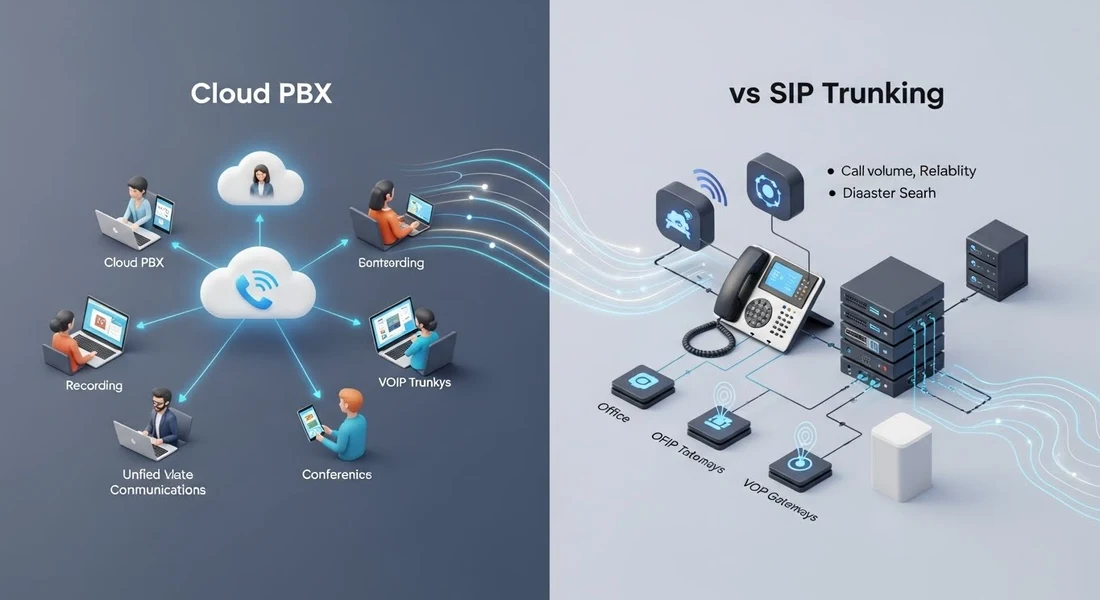
Choosing the right business phone system can feel overwhelming. With options like Cloud PBX vs SIP Trunking companies often struggle to balance cost control and scalability. Should you move entirely to the cloud or leverage your existing PBX infrastructure with SIP Trunks?
In this article we break down everything you need to know. From deployment and call quality to security compliance and feature comparisons this guide will help you make an informed choice. By the end you’ll understand which solution aligns with your business needs and growth plans.
What is Cloud PBX and How It Works?
Cloud PBX is a hosted business phone system that runs entirely over the internet. Instead of maintaining physical hardware on site all call processing management and updates happen off site with a service provider. This makes it ideal for businesses that want minimal IT involvement while accessing advanced PBX features.
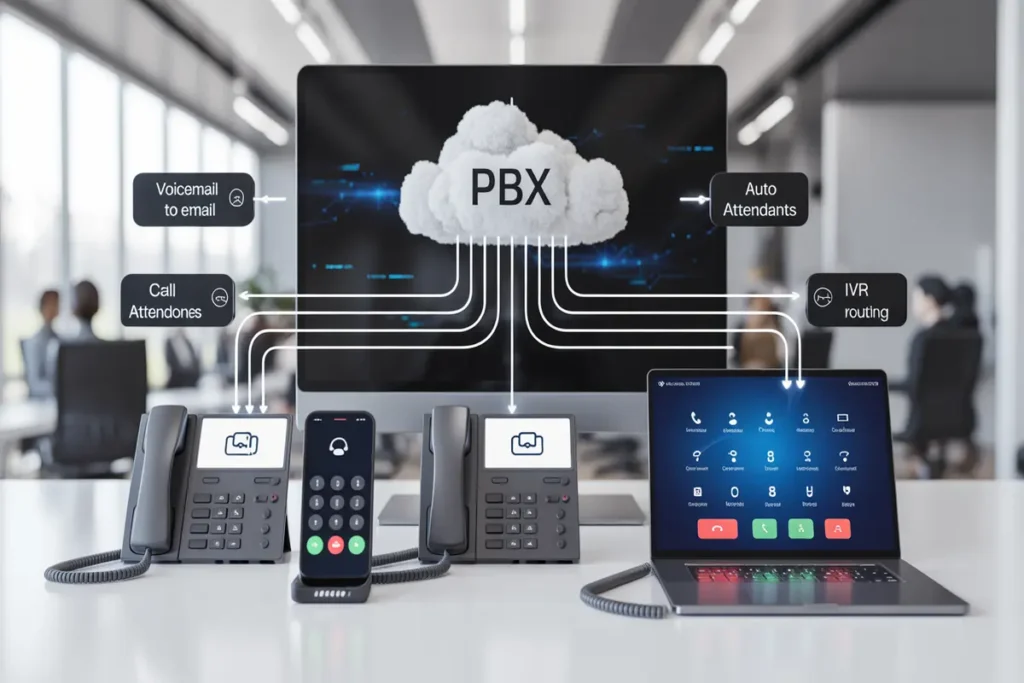
Cloud PBX allows employees to connect via desk phones, softphones or mobile apps. It provides features like call routing voicemail to email auto attendants and interactive voice response (IVR). The system’s infrastructure is maintained and updated by the provider reducing ongoing maintenance costs for businesses.
Key Features of Cloud PBX
Cloud PBX comes equipped with a robust set of features designed to improve business communication. Call routing ensures calls reach the right department or individual while auto attendants and IVR provide a professional touch. Voicemail to email and call recording enhance accountability and tracking. Video calling and conferencing support collaboration even for remote teams and softphone support enables employees to use their computers or mobile devices as extensions.
The platform also integrates with CRM systems providing seamless access to customer information during calls. This integration streamlines workflows making it easier for sales and support teams to manage interactions efficiently.
Benefits of Cloud PBX
Cloud PBX provides several advantages. The main benefit is reduced upfront cost. Since the provider hosts the PBX infrastructure businesses only need phones and an internet connection. Maintenance is handled externally freeing IT staff from managing hardware and software upgrades.
Scalability is another advantage. Cloud PBX systems can grow with your business allowing new users or extensions to be added with minimal disruption. Remote work is simplified as employees can connect from anywhere using softphones, mobile apps or web interfaces.
Drawbacks of Cloud PBX
Despite its benefits Cloud PBX has limitations. Call quality is dependent on internet reliability and bandwidth. If connectivity is poor audio can become choppy and calls may drop. There is less flexibility compared to on premise systems; customization options are limited by the provider’s capabilities. Security is also partially outsourced, requiring trust in the provider’s encryption and firewall measures.
What is SIP Trunking and How It Enhances Your PBX?
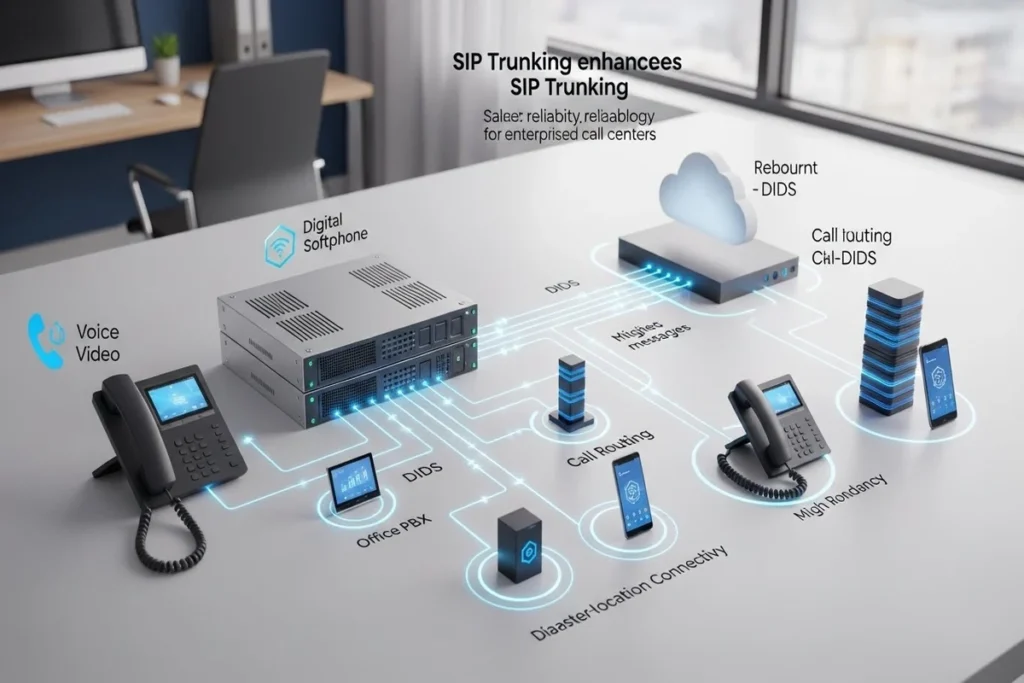
SIP Trunking connects your existing on premise PBX system to the internet allowing your business to send and receive voice video and messaging over IP networks. Unlike Cloud PBX SIP Trunks leverage the PBX you already own, enhancing its capabilities without replacing it entirely.
This solution provides a bridge between traditional telephony and VoIP using session initiation protocol (SIP) to manage calls. SIP Trunking supports multiple channels enabling simultaneous calls and can scale to accommodate growing business demands.
SIP Trunks also improve redundancy and reliability. With proper setup your system can include failover lines, disaster recovery protocols and multi location support. This makes it particularly appealing to enterprises and call centers that require high uptime and predictable performance.
Key Capabilities of SIP Trunking
SIP Trunking delivers features like inbound and outbound calls, DIDs number porting and high channel capacity. Advanced call routing voicemail and IVR can still be managed through your existing PBX. Integration with CRM systems and APIs allows businesses to maintain workflows and automate processes.
Unlike hosted systems SIP Trunking can be customized to meet specific operational needs. It supports both voice and data on the same connection making it cost efficient for high volume call centers. Security can be fully controlled by IT teams with firewall traversal NAT VPN and encryption configured internally.
Benefits of SIP Trunking
SIP Trunking offers significant cost savings for businesses with existing PBX infrastructure. You pay for trunk capacity rather than per user subscriptions which is ideal for organizations with many simultaneous calls.
The solution is highly scalable supporting multiple locations, global reach and high call volumes without sacrificing call quality. Businesses retain complete control over maintenance upgrades and security allowing customization and integration with enterprise systems.
SIP Trunks also reduce dependency on traditional phone lines enabling more flexibility and advanced features like unified messaging video calls and web conferencing.
Drawbacks of SIP Trunking
SIP Trunking requires technical expertise for setup and ongoing management. IT teams must handle firewall configurations, QoS settings and SIP endpoints. Emergency calling (e911) setup requires careful attention.
Businesses without existing PBX hardware may face high upfront costs. Integration with older PBX systems may require additional hardware like VoIP gateways. For companies without technical staff management and troubleshooting can become resource intensive.
Key Differences Between Cloud PBX and SIP Trunking
Choosing between Cloud PBX and SIP Trunking depends on multiple factors: infrastructure cost scalability management and business goals.
Cloud PBX offers rapid deployment, minimal IT involvement and monthly subscription pricing. SIP Trunking leverages existing PBX hardware allowing greater control, higher scalability for call centers and lower long term cost for high volume users.
Call quality redundancy and security vary depending on internet connectivity and IT management. While Cloud PBX relies on the provider’s network, SIP Trunking allows businesses to configure their own infrastructure to ensure performance and compliance.
Deployment & Infrastructure
Cloud PBX is fully cloud hosted requiring no physical hardware beyond phones. SIP Trunking relies on on premise PBX systems or hybrid configurations. The deployment model affects scalability flexibility and control over features and call management.
Cost & Pricing Model
Cloud PBX uses per user subscription fees making it predictable but potentially costly for large teams. SIP Trunking is typically per channel which can reduce expenses for high volume enterprises. Setup costs ongoing maintenance and licensing models vary between the two solutions.
Scalability & Business Growth
Cloud PBX scales easily for SMBs or distributed teams with new users added through a provider portal. SIP Trunking scales by adding channels and expanding PBX capacity which is better suited for large businesses or call centers with high simultaneous call demands.
Call Quality Reliability & Performance
Cloud PBX depends on internet reliability and bandwidth. SIP Trunks can leverage private networks or optimized PBX configurations to ensure superior audio quality and minimize jitter latency and packet loss. Disaster recovery and failover setups can enhance uptime in SIP deployments.
Security Compliance & Risk Management
Cloud PBX security is provider managed, requiring trust in external encryption and firewall policies. SIP Trunks provide full control over security protocols VPNs and NAT traversal. Compliance with e911 regulatory standards and internal IT policies can be configured directly for SIP based systems.
Cloud PBX vs SIP Trunking Comparison Table
| Feature | Cloud PBX | SIP Trunking |
| Deployment | Fully hosted | On premise + SIP provider |
| Setup Time | Quick | Moderate technical setup required |
| Cost Model | Per user subscription | Per channel pricing |
| Scalability | SMB & remote friendly | High volume & multi location |
| Call Quality | Dependent on internet | Can use private IP networks |
| IT Control | Provider managed | Full internal control |
| Redundancy | Provider handled | Configurable by IT |
| Ideal Users | Small medium teams | Call centers & enterprises |
Which Solution is Right for Your Business
Businesses with small teams limited IT resources or a focus on mobility benefit from Cloud PBX. Companies with high call volumes, multi location operations and existing PBX hardware find SIP Trunking more cost effective and scalable.
Consider your growth plans, IT expertise budget and required features when making the decision. For call centers or outbound sales teams SIP Trunking often provides better control integration and reliability.
SIP Trunking for Call Centers and Sales Teams
SIP Trunks support advanced dialer integrations CRM connectivity and compliance friendly workflows. They ensure high simultaneous call capacity and maintain caller ID reputation to prevent spam labeling. Businesses can also manage outbound campaigns, track analytics and integrate API solutions for automated workflows.
Choosing the Right SIP Trunking Provider
Select a provider that ensures reliability, global DID availability, security compliance and seamless PBX integration. RockyDialer offers high volume SIP Trunking enterprise grade infrastructure and support to handle mission critical business communications.
Conclusion
Both Cloud PBX and SIP Trunking offer unique advantages. Cloud PBX is ideal for SMBs or businesses seeking simplicity and mobility. SIP Trunking is better for call centers enterprises or companies with existing PBX infrastructure looking to optimize costs control and performance.
Evaluate your IT capabilities growth plans call volume and budget. By understanding the differences and benefits you can select a solution that aligns with your business needs, ensures reliability and supports your communication strategy for years to come.
FAQs
Can I switch from Cloud PBX to SIP Trunking later?
Yes many businesses start with Cloud PBX and transition to SIP Trunks as call volume grows or existing PBX infrastructure is added.
Which solution is cheaper for a large call center?
SIP Trunking usually provides lower per channel costs and greater control making it ideal for high volume enterprises.
Can Cloud PBX support remote teams?
Absolutely. Cloud PBX allows employees to connect using softphones, mobile apps or desk phones from any location.
Do I need technical expertise to use SIP Trunking?
Yes SIP Trunking requires IT staff for setup firewall configuration and ongoing management.
Which solution offers better call quality?
SIP Trunking can provide higher quality calls when configured over private networks while Cloud PBX relies on internet quality.
Is SIP Trunking compatible with my existing PBX?
Most modern PBX systems support SIP Trunks. Ensure your system is SIP enabled or consider adding a VoIP gateway.
Are Cloud PBX and SIP Trunking secure?
Both are secure if properly configured. Cloud PBX security depends on the provider while SIP Trunks allow full internal control over encryption and firewalls.